
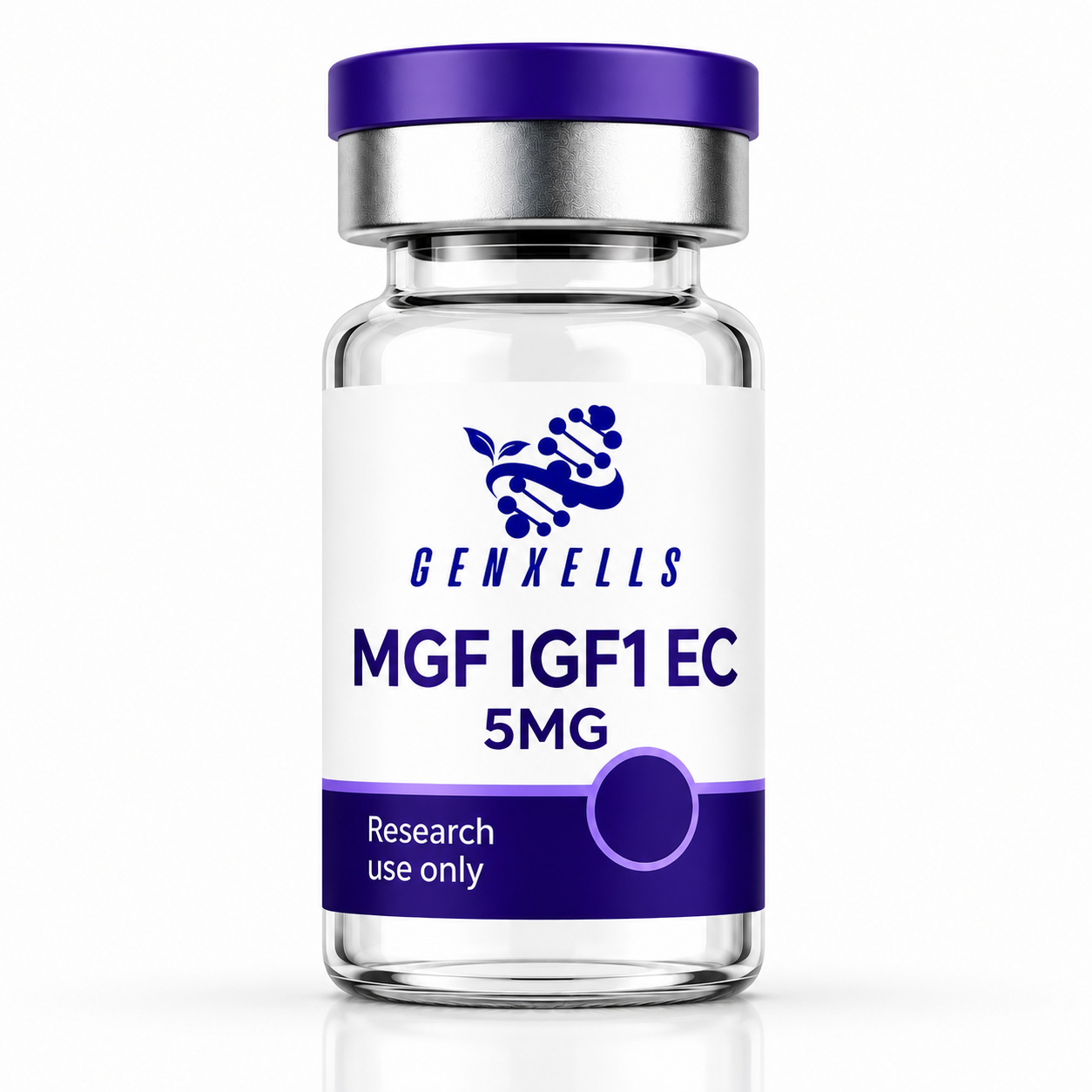

Buy MGF IGF1 EC 5mg Online
Buy MGF IGF1 EC 5mg Online, also known as IGF-1 Ec, is a naturally occurring splice variant of the insulin-like growth factor-1 (IGF-1) gene. It is produced locally in muscle tissue following mechanical stress, resistance exercise, or muscle injury and has become an important subject of research in muscle biology and regenerative medicine.
Scientists have investigated MGF because of its potential role in activating muscle satellite cells, supporting tissue repair, and regulating skeletal muscle adaptation. While laboratory and animal studies have provided valuable insights into its biological functions, synthetic MGF remains an investigational research peptide and has not been approved by the U.S. Food and Drug Administration (FDA) or other major regulatory agencies for therapeutic use in humans. Current evidence does not establish its safety or effectiveness for routine clinical use.
For educational information about peptide science and biomedical research:
Website: https://genxells.com/
Email: info@genxells.com
What Is MGF (IGF-1 Ec)?
MGF is a splice variant of the IGF-1 gene that is naturally expressed in skeletal muscle following mechanical loading or injury. Unlike circulating IGF-1, MGF is produced locally within tissues and is believed to participate in the early stages of muscle repair.
Researchers distinguish MGF from other IGF-1 variants because of its unique C-terminal peptide sequence, which appears to influence muscle stem cell activity during tissue regeneration. This has made MGF an important research tool for studying exercise physiology, muscle recovery, and regenerative biology.
How Does MGF Work?
Experimental research suggests that MGF is released after muscle fibres experience mechanical stress.
Laboratory studies indicate that MGF may:
- Activate muscle satellite cells.
- Support myoblast proliferation.
- Participate in early tissue repair.
- Influence cellular signalling involved in muscle regeneration.
- Interact with pathways associated with IGF-1 biology.
Most of these findings come from cell culture and animal studies, and their clinical relevance in humans remains uncertain.
Areas of Scientific Research
Muscle Biology
The largest body of research involving MGF focuses on skeletal muscle adaptation.
Scientists investigate how MGF contributes to:
- Muscle repair after injury.
- Cellular regeneration.
- Satellite cell activation.
- Muscle remodelling following exercise.
These studies improve understanding of normal muscle physiology but should not be interpreted as evidence of proven therapeutic benefit.
Regenerative Medicine
Researchers continue exploring whether MGF-related signalling pathways may contribute to future regenerative medicine strategies.
Areas of investigation include:
- Tissue regeneration.
- Stem cell biology.
- Cellular repair mechanisms.
- Recovery following experimental muscle injury.
These applications remain experimental.
Aging Research
Age-related loss of muscle mass (sarcopenia) is another area of scientific interest.
Laboratory studies examine whether altered IGF-1 signalling contributes to age-related changes in muscle regeneration. At present, there is no approved MGF-based treatment for sarcopenia.
Exercise Physiology
Exercise scientists use MGF to better understand how resistance training influences muscle adaptation.
Current evidence supports the role of naturally produced MGF in physiological responses to exercise, but this should not be confused with evidence supporting synthetic MGF administration.
Current Scientific Evidence
Research involving MGF includes:
- Cell culture experiments.
- Animal studies.
- Molecular biology research.
- Exercise physiology investigations.
Importantly, no well-established human clinical trials are demonstrating that synthetic MGF is safe or effective for medical treatment or athletic performance enhancement. Most available evidence remains preclinical.
Regulatory Status
Current regulatory information includes:
- No FDA-approved MGF medicine exists.
- No EMA-approved therapeutic product is available.
- MGF remains a research-only compound.
- It is prohibited by the World Anti-Doping Agency (WADA) because it falls within growth factor–related substances.
Availability through research suppliers does not indicate regulatory approval or established clinical effectiveness.
Safety Considerations
Because synthetic MGF has not completed the regulatory approval process, important questions remain regarding:
- Long-term safety.
- Appropriate dosing.
- Drug interactions.
- Potential effects on growth-factor signalling.
- Risks associated with products manufactured outside regulated pharmaceutical standards.
Growth-factor pathways influence many biological processes, so manipulating these pathways without established clinical evidence may involve unknown risks.
Importance of Evidence-Based Care
Individuals experiencing muscle weakness, sports injuries, endocrine disorders, or other medical concerns should seek evaluation from qualified healthcare professionals.
Evidence-based management may include:
- Physical therapy.
- Structured rehabilitation.
- Exercise programs.
- Nutritional guidance.
- Approved medications when indicated.
- Ongoing medical monitoring.
These approaches have substantially stronger clinical support than investigational peptides.
Future Research
Scientists continue investigating MGF to better understand:
- Skeletal muscle regeneration.
- Stem cell activation.
- Tissue repair.
- Exercise adaptation.
- Healthy ageing.
- Growth-factor biology.
Future clinical studies may clarify whether aspects of MGF biology can contribute to new therapeutic approaches, but additional high-quality research is essential before any clinical role can be established.
Frequently Asked Questions
What is MGF (IGF-1 Ec)?
MGF is a naturally occurring splice variant of the IGF-1 gene that is produced locally in muscle tissue following mechanical stress. It has become an important subject in muscle biology and regenerative medicine research.
Is MGF FDA-approved?
No. Synthetic MGF has not been approved by the FDA or other major regulatory authorities for therapeutic use in humans.
What has MGF been researched for?
Researchers have investigated muscle regeneration, exercise physiology, tissue repair, satellite cell biology, ageing research, and regenerative medicine. Most evidence remains preclinical.
Is more research needed?
Yes. Larger, well-designed human clinical trials are needed to determine the safety, effectiveness, and potential therapeutic applications of synthetic MGF.
Learn More
For educational information about peptide science and biomedical research:
Website: https://genxells.com/
Email: info@genxells.com
Final Thoughts
MGF (IGF-1 Ec) has significantly advanced scientific understanding of muscle regeneration, exercise physiology, and growth-factor signalling. Research suggests that naturally produced MGF plays an important role in the body’s response to muscle injury and mechanical loading, particularly through activation of satellite cells involved in tissue repair. However, synthetic MGF remains an investigational compound, and there is currently no regulatory approval for its therapeutic use in humans. Individuals seeking treatment for muscle injuries, endocrine disorders, or age-related muscle loss should consult qualified healthcare professionals and rely on therapies supported by rigorous clinical evidence and established medical guidelines. Continued research may further clarify the biological significance of MGF while ensuring that future therapies meet appropriate standards for safety and effectiveness.
Be the first to review “Buy MGF IGF1 EC 5mg Online”
Related products

Peptide
Peptide
Peptide
Peptide
Peptide
Peptide

Peptide
Reviews
There are no reviews yet.